

Choosing between Node.js and Django often comes down to backend performance and scalability needs for modern apps. In this Node.js vs Django performance and scalability comparison, we’ll explore backend performance comparison metrics, Node.js scalability strengths, Django scalability approaches, and why both rank among the best backend framework 2026, backed by benchmarks, real case studies like Netflix and Instagram, and practical tips. You’ll gain clear insights to pick the right framework for high-traffic projects in 2026, whether real-time APIs or data-heavy platforms.
Node.js vs Django
Core Differences
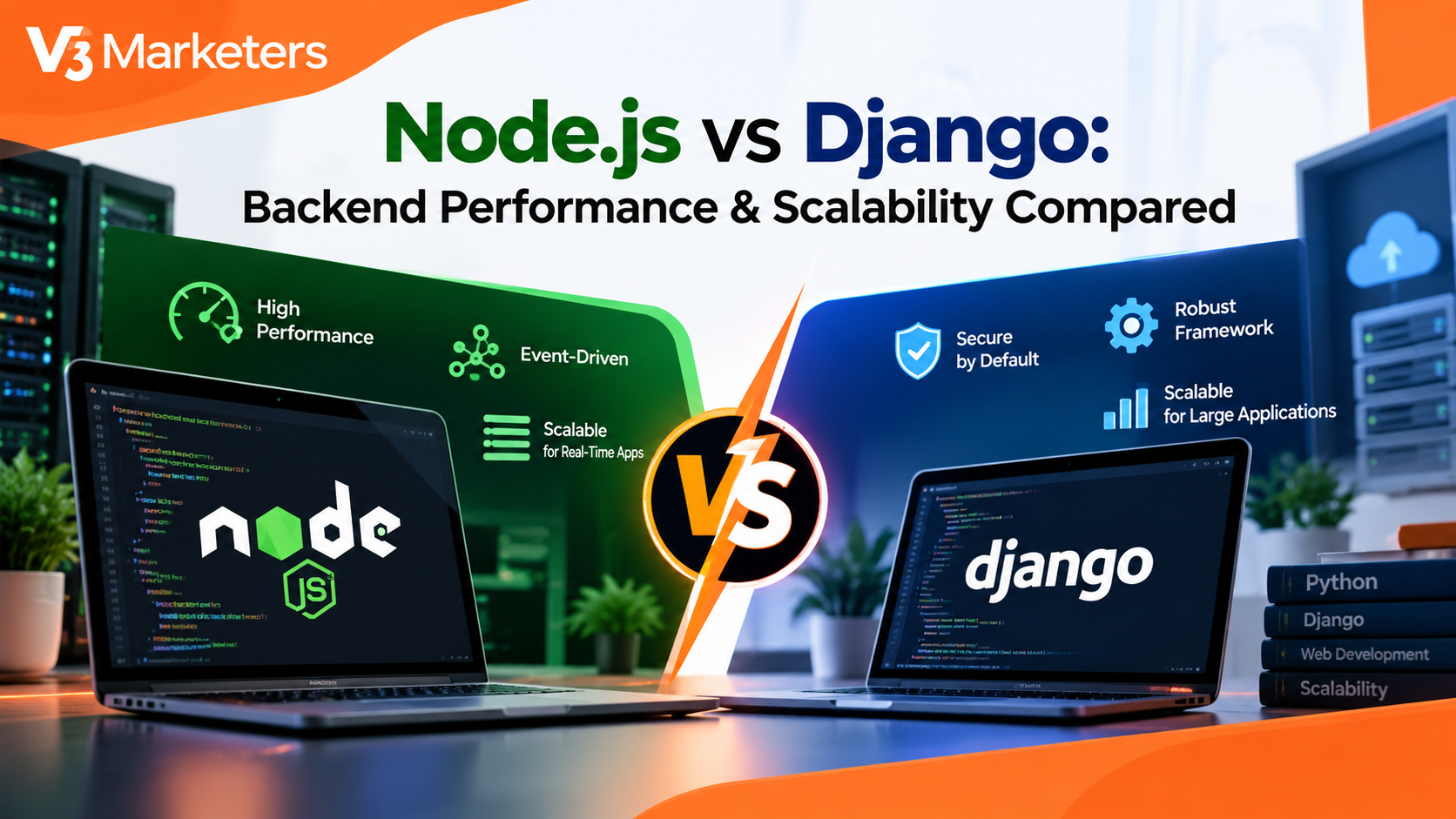
- Being a JavaScript framework Node.js is designed for building programs using an event-driven, single-threaded execution model without blocking/waiting for I/O. It can therefore serve as an ideal platform for building real-time tools. On the other hand, Django Python, based on the MTV pattern along with ORM support, admin interfaces, and security features; thus, is thus suitable for speedy development of applications.
- When we are comparing js vs Django performance- Node.js is good at handling multiple connections, while Django handles requests in a synchronous way unless it is an async view.
- Backend performance comparison reveals the fact that Node.js is faster for simple APIs, but Django is more efficient for database-intensive operations.
Performance Breakdown
- js vs Django performance Benchmarks shows advantages of Node.js in concurrency. It typically doubles throughput in tests like Apache Bench for I/O tasks. Node.js is able to handle 50, 000+ connections without problems because of its event loop.
- Django has become more scalable with ASGI and Channels from version 3.1, however, Python’s GIL still limits the scaling over multiple cores unless workers such as Gunicorn are used.
- In backend performance comparison, Node.js wins raw speed (e.g., 2x requests/sec in JSON serialisation), per TechEmpower, style rounds where JS frameworks top Python ones.
Scalability Insights
- js scalability excels via clustering, PM2, and Docker for horizontal growth, handling unpredictable spikes effortlessly. It’s low-memory per instance.
- Django scalability largely relies on Redis caching, database sharding, and load balancers; vertical scaling works well with steady workloads.
- When it comes to js vs Django scalability, Node.js has an edge in real-time chats or streams; Django for content sites. Survey results show that Node.js accounts for 91% of the scalable web applications.
Real-World Case Studies
- Netflix uses Node.js for handling the scalability of billions of API calls each day. Since it switched from Java, Netflix has reduced latency by 70%. It is able to manage a peak of 200M+ users.
- Uber’s real-time dispatch system is built with Node.js and is capable of handling thousands of ride requests every minute, thanks to the event-driven nature of the technology.
- Instagram is a showcase of Django scalability as it has more than 2 billion users. It breaks down its PostgreSQL database into smaller parts only for the feeds and stories. Highly optimised queries are used in the process.
- Pinterest (Django) serves 433M users monthly, using it for pins and recommendations reliably.
- Internal dev experience: Node.js reduced LinkedIn servers from 30 to 3; Django sped e-commerce builds 40% with less code.
These show Node.js vs Django performance in action- Node.js for speed, Django for structure.
Microservices Fit
- js vs Django in microservices: Node.js works great with minimal Express services, each scaling independently through Kubernetes.
- Django is a good fit for data-heavy services but requires additional work for async communication; it is very effective when moving from monoliths to micros.
- Backend performance comparison here favours Node.js for high-volume, low-latency micros.
Best Backend Framework 2026
- js is voted as the best backend framework in 2026 for performance and scalability by 550k+ sites. Security and rapid development are the points on which Django is ranked second after Node.js.
- The performance comparison between Node.js and Django reveals that Node.js is certainly the best choice for APIs; whereas Django is perfect for full-stack CRUD operations. Both are at the forefront followed by Go/FastAPI.
- In the top 10k websites, 1.3% of them (Node.js) represent the high traffic leaders while Django is at 0.2% but enterprise, proven.
Conclusion
Node.js leads Node.js vs Django performance and Node.js vs Django scalability for I/O-intensive apps like streaming or chats, as seen in Netflix/Uber. Django offers superior Django scalability for data-driven platforms like Instagram with faster prototyping.
Choose Node.js for peak Node.js scalability in real-time 2026 projects; Django for robust backend performance comparison wins in secure apps. Both are the best backend framework 2026 options, prototype to decide.
FAQs
Q1. Which is faster: Node.js or Django for backend development?
A: Node.js is a great tool to handle live traffic quickly, e.g., it is ideal for a chat app or other situations with constant heavy user engagement. Django is an organised toolkit that saves your time as the majority of the work is already done for you.
Q2. Is Node.js more scalable than Django for high-traffic applications?
A: Yes, Node.js is more scalable in general for high-traffic applications that require real-time updates due to its non-blocking, event-driven architecture. Django, on the other hand, is also scalable but it might be best for data-rich applications and fast or secure development.
Q3. When should I choose Django over Node.js for my project?
A: If you require an all-in-one approach to manage security and data then opt for Django and it is great for fast development as well. Whereas if you want an extremely reactive and very engaging app then go ahead and develop using Node.js as an example: live chat.
Q4. Can Node.js and Django both handle enterprise-level applications?
A: Both can handle enterprise apps at a huge scale. Netflix/Uber uses Node.js to maintain real-time global traffic. On the other hand, Instagram/Pinterest uses Django to regulate more than 2 billion users with intricate data.
Q5. How do Node.js and Django perform in a microservices architecture?
A: Node.js excels in microservices with lightweight, async services offering low latency and easy Kubernetes scaling, suiting high-volume APIs. Django performs well for data-intensive services using DRF but requires ASGI/Gunicorn config; it’s stronger for cohesive services transitioning from monoliths.