

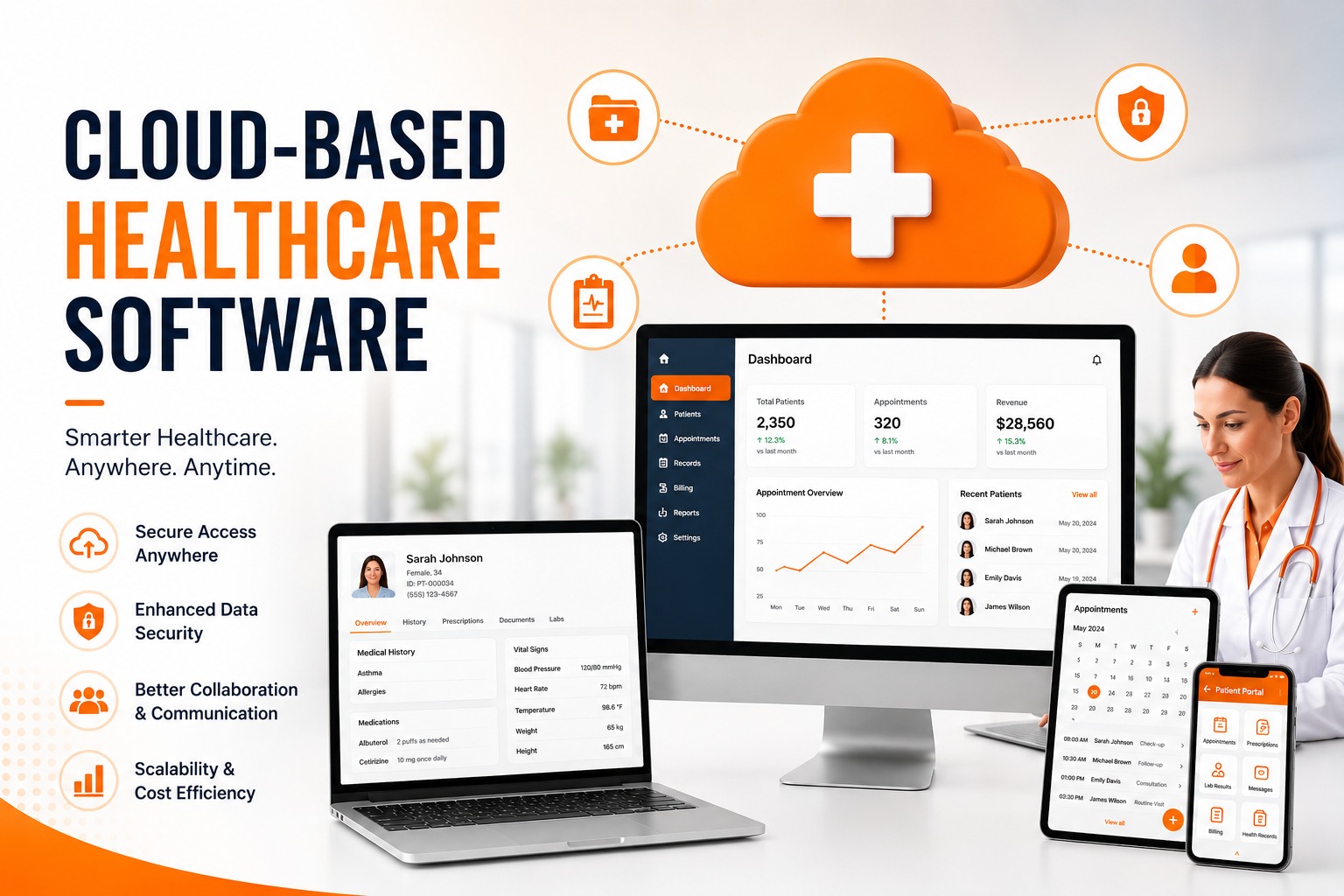
Cloud-Based Healthcare Software in 2026 has seen its role shift from a luxury to a clinical necessity. This guide shows how physicians and other healthcare professionals have used cloud technology to raise the quality of patient care, the potential dangers of the digital move, and the dos and don’ts for carrying out the change. Besides learning how to balance security with accessibility, you will also understand the intricacies of Custom E-commerce Development for medical retail and why E-commerce Scalability is the heartbeat of a growing practice. This in-depth study outlines a roadmap to Sustainable Business Growth Solutions, one of which is SaaS Platforms or specialised Retail Software.
The Shift to Cloud-Based Healthcare Software
The healthcare industry has seen a huge digital transformation. By 2026, around 85% of healthcare organisations were using the cloud for handling Electronic Health Records (EHR) and telehealth services. The primary driver? The need for a unified Web Application Development strategy that connects patients with providers in real-time.
Key Benefits of Cloud Adoption
-
- Interoperability: Different systems, such as lab results, pharmacy records, etc., can communicate with each other flawlessly if cloud-based platforms are used.
- Cost Efficiency: Clinics that use SaaS Platforms can significantly cut down the requirement for costly on-site servers and IT maintenance teams.
- Enhanced Accessibility: A doctor can get hold of a patient’s critical data from any device lying anywhere, thus, the diagnosis and treatment get faster.
- E-commerce Scalability: Cloud-Based Platforms help clinics that sell medical supplies or supplements to scale their business and manage traffic spikes without any downtime.
Navigating Risks and Security
While the benefits are vast, the stakes in healthcare are incredibly high. Data breaches in 2026 can cost providers millions in fines and, more importantly, loss of patient trust.
- Security Vulnerabilities: Unlike standard Online Store Solutions, healthcare software must adhere to strict HIPAA and GDPR standards. A leak isn’t just a business failure; it’s a legal catastrophe.
- Compliance Complexity: Constant updates in healthcare regulations mean your Retail Software must be agile enough to adapt.
- Downtime Risks: In a clinical setting, a five-minute outage isn’t just a lost sale; it’s a delayed surgery or a missed prescription alert.
E-commerce in Healthcare: Custom vs. SaaS
Many modern healthcare providers now operate digital storefronts. Choosing between Custom E-commerce Development and a SaaS for eCommerce platform is a critical crossroads.
Custom E-commerce Development
For organisations with very specific workflows, e.g. heavy insurance integrations or patient portals with certain features, a custom development can provide a high level of flexibility which is otherwise unachievable.
- Pros: Being in total control of the user journey, having unique features and a Web Application Development that meets the niche medical needs perfectly.
- Cons: More expensive initially and longer time to market.
SaaS Platforms (Shopify & Magento)
Shopify Development and Magento Development have become a necessity for medical retailers who need to launch fast.
- Shopify Development: Best for D2C medical brands looking for a user-friendly interface and rapid deployment.
- Magento Development: Ideal for B2B medical wholesalers requiring robust catalogue management and deep Business Growth Solutions.
Best Practices for 2026
To thrive in the contemporary market, healthcare and retail businesses must follow these three pillars:
Prioritise “Security by Design”
Never consider security as an afterthought. Whether you are switching to Magento development or creating a completely new one, get Zero Trust architecture embedded right from the first day. By 2026, identity will be the new perimeter.
Focus on E-commerce Scalability
Your Retail Software should be able to handle a 10x increase in load overnight. This is why Cloud-Based Platforms are superior; they offer elastic resources that grow as your patient or customer base expands.
Seek Integrated Business Growth Solutions
The most successful organisations don’t see their software as a silo. Your Online Store Solutions should talk to your CRM, your EHR, and your accounting software. Data-driven decision-making is the only way to ensure sustainable growth.
Case Study: The 2025 MedTech Pivot
A mid-sized clinic recently transitioned from a legacy on-premise system to a hybrid of Custom E-commerce Development for their patient portal and Shopify Development for their wellness shop.
The Result: A 40% increase in patient engagement and a 25% reduction in administrative overhead. By utilising Business Growth Solutions that synchronised their data, they managed to scale to three new locations without increasing their IT headcount.
Conclusion
The intersection of Cloud-Based Healthcare Software and modern Retail Software is where the future of patient care and medical commerce lies. By choosing the right Web Application Development path – be it the agility of SaaS Platforms or the power of Custom E-commerce Development, your business can achieve unprecedented E-commerce Scalability.
FAQs
Q1. What is the difference between custom e-commerce and SaaS platforms?
A: Custom E-commerce Development is when you get the platform created totally from scratch or with a flexible framework that allows you to have full ownership of the code. SaaS Platforms (Software as a Service) are subscription-based models where the provider hosts the software and you “rent” the functionality.
Q2. Which is better for scaling a growing business?
A: For most, SaaS Platforms offer the quickest E-commerce Scalability. However, for enterprise-level entities, Custom E-commerce Development provides the long-term architecture needed to scale without hitches in proprietary logic.
Q3. How secure is custom e-commerce compared to SaaS?
A: SaaS providers handle “platform-level” security (like SSL and PCI compliance) automatically. Custom solutions require you to build and maintain your own security protocols, which can be “tighter” but require expert Web Application Development to stay ahead of threats.
Q4. Can SaaS platforms be customised for unique business needs?
A: Yes, especially through “Headless” architecture. Modern Shopify Development offers a great deal of front-end customisation to the user. However, the main checkout logic is still kept within the SaaS framework.
Q5. What is the long-term cost comparison?
A: SaaS needs less money to get started, but requires you to keep paying monthly fees and percentages on transactions. Custom builds at first demand a substantial amount of money, but as the continuing costs are low, it is typical for them to be more cost-effective after 3 to 4 years of extremely high sales.
Q6. Which option offers better control over features and updates?
A: Custom E-commerce Development wins here. You decide when to update and what features to add, whereas SaaS users are at the mercy of the platform’s global update schedule.
Q7. How does user experience differ between custom and SaaS solutions?
A: SaaS provides a “proven” UX that customers find familiar. Custom solutions allow you to create a “signature” experience that can be optimised for specific patient or practitioner behaviours, leading to better Online Store Solutions and conversion rates.