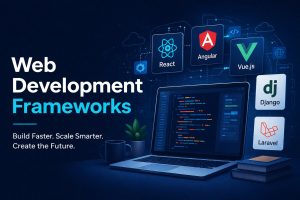


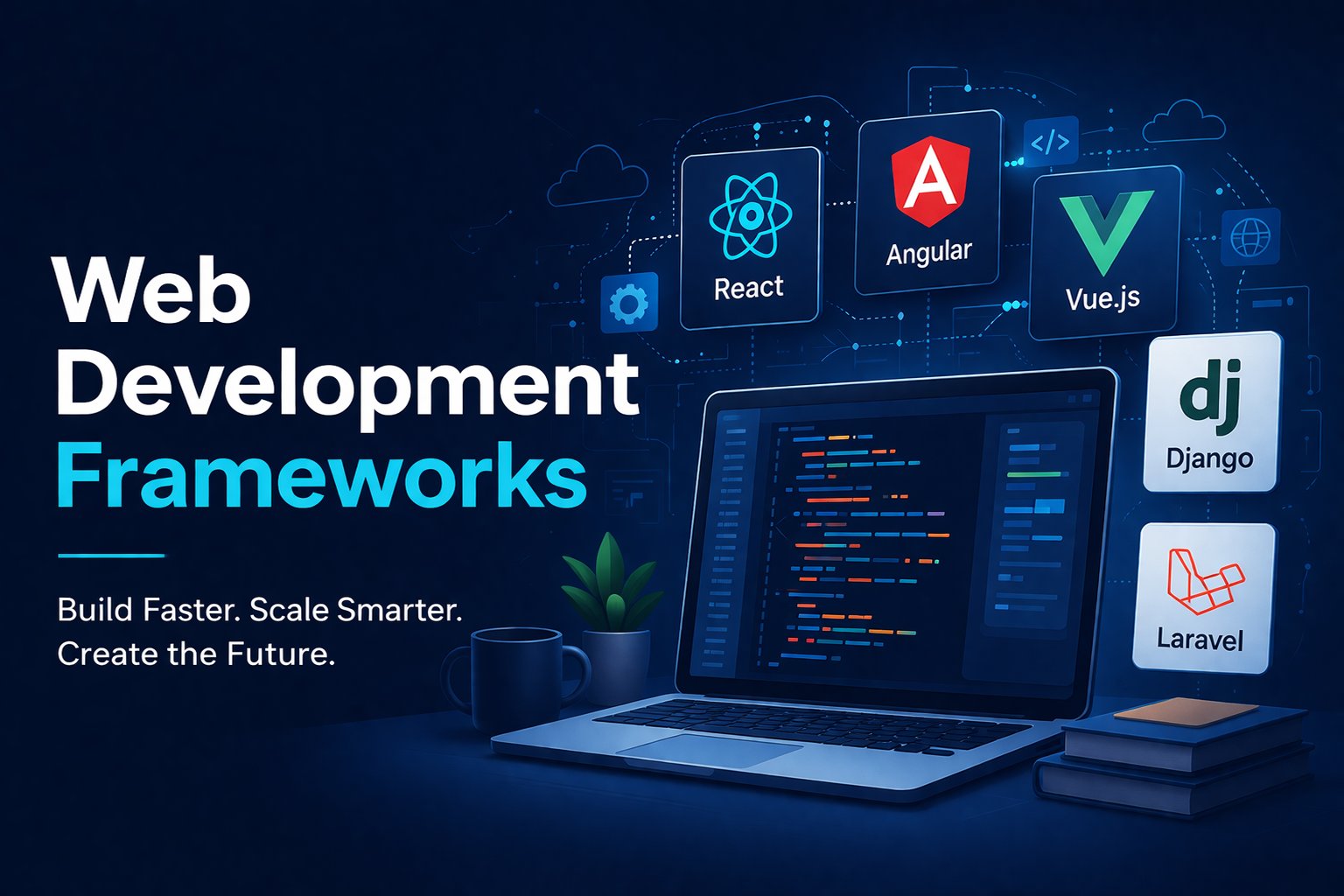
In today’s fast-paced digital world, developing a website from scratch is like making a car by assembling every single nut and bolt yourself, which is time-consuming and leaves too much room for error. This is where web development frameworks come in.
Web frameworks are built from many prewritten code, tools, and libraries that provide a base on which a project can be built. The right choice of web framework can be an important decision for any web developer, whether you’re looking at choosing the best backend framework or determining which are the most popular frontend JavaScript libraries.
This guide will examine the most popular frameworks that the world’s leading companies use to build scalable web-based applications and high-performing websites.
Top Web Development Frameworks
1. React: The King of Frontend Development
Our daily apps (e.g., Instagram and Netflix) rely on React, Facebook’s open-source JavaScript library for creating user interfaces. With React, developers can create performant, contemporary web applications via reusable components (like building blocks). Instead of reloading the entire screen, React allows pages to update only the parts that have changed when new content is requested. React provides a huge array of resources and tools for building scalable/flexible interfaces regardless of the developer’s level of expertise.
2. Django: The High-Level Python Framework
Django is a robust platform for Python developers to develop secure, professional-looking websites quickly and efficiently. Originally, Django was built to provide time-critical newsrooms with a very fast, reliable development process. You can think of Django as a “batteries included” framework, providing almost everything you require to get started with minimal effort on your part, and you will be able to develop world-class websites very quickly! Major companies like Pinterest and Instagram have successfully used Django, and they trust Django to handle very large volumes of traffic and to protect their users’ sensitive information.
3. Angular: The Enterprise Powerhouse
Since it was developed by Google, Angular is a robust framework that is meant for building complex web applications with maximum performance. It’s often chosen for large projects because it provides a structure to help keep code organised as the project grows larger. Whether it be by using Angular for YouTube, Weather websites, etc., you know that you will build a site that is fast and dependable. There is a little bit of a learning curve associated with Angular, but once you are comfortable with it, you will be able to handle large and complex data easily, making it a desirable choice among the current generation of programmers.
4. ASP.NET: The Microsoft Standard
ASP.NET by Microsoft can be thought of as an extremely efficient motor for web applications. It can be used to develop both large-scale and small-scale, professional-looking websites or mobile applications. It has a light-weight and fast design that makes it able to support high volumes of web traffic (and is used by sites like Stack Overflow) and is based upon the C# coding language which combines high levels of functionality with high levels of productivity, making it an ideal tool for development teams requiring their applications to be secure, fast and dependable.
5. Flask: The Lightweight Alternative
Flask is a fantastic choice if you want an easy-to-use, completely customised platform (like dictionaries) where there are no restrictions imposed upon you, so you are free to create whatever you want – whether that is small applications or more complex projects such as web services. Since Flask doesn’t require any additional coding or knowledge of programming languages, it is also a great way to get started with building your first website! Well-known companies such as Reddit and Netflix use Flask for its lightweight and fast development capabilities and flexibility.
6. Vue.js: The Progressive Framework
Vue.js was developed by Evan You, who is a designer for the web. The framework is known for being the “friendly” framework, which allows you to create modern-day websites with little to no experience. Vue.js is much easier to learn than traditional rigid frameworks and does not limit your ability to develop your project as you would like to. The “component-based” structure (building with blocks) keeps your code organised and runs quickly. The simplicity and speed that global companies such as Alibaba and GitLab enjoy while using the framework speak to why so many developers are using it today.
7. Express.js: The Heart of Node.js
Express is the primary tool when creating fast and dependable servers using Node.js. Express is described as a “minimalistic” framework due to the lack of unnecessary features in the framework, which allows developers to add only the things that they want through the use of plugins. As such, Express has become a critical piece of the famous MEAN stack. As a result, Express allows developers to write fast and simple APIs as well as complex web applications without having to worry about managing a lot of unnecessary features.
8. Spring Boot: Java for the Modern Era
Java developers can use Spring Boot to develop applications faster compared to setting up complex configurations that require long hours to configure by hand. Spring Boot, from Pivotal, claims to provide everything that a developer needs to immediately begin building robust applications that are production-ready, meaning stable and safe from day one. Spring Boot will take care of the burden of the details so that major corporations, such as Netflix and Alibaba, can run their large systems smoothly without having to worry about peripherals.
9. Ruby on Rails: The Startup Favourite
Ruby on Rails has been developed by David Heinemeier Hansson as an ideal way to quickly develop websites using a framework that works quickly compared to most standard web development frameworks, such as Java. Think of Ruby on Rails as the engine behind the scenes, using the MVC framework to turn complex databases into the friendly web interfaces we use every day. Since it powers the sites we love, like Airbnb, Shopify, and GitHub, it stays a top choice for developers worldwide.
10. Laravel: Elegant PHP Development
Laravel (released in 2011) is a popular open-source web framework developed by Taylor Otwell, often considered a PHP framework. Laravel is also based on the MVC design pattern, with everything inside controllers, models and views properly separated, allowing for ease of reading when developing your website. Beginners will have no problem learning how to use Laravel because Laracasts has provided over one hundred helpful video tutorials for you to use to learn. Many well-known sites like Deltanet Travel utilise Laravel, making it a popular choice for developers who want a clean and beautiful codebase.
Read More: How to Fix HTTP 302 Status Code
Frequently Ask Questions
1. What are the most popular web development frameworks in 2026?
A: React leads for front-end work, although Django or Express.js handles back-end tasks. Big Java companies still prefer Spring Boot.
2. Which framework should a beginner learn first?
A: If you want to build the look of a website, start with Vue.js or React. If you want to build the “brain” (backend), Flask (Python) or Laravel (PHP) are very beginner-friendly.
3. Do I need to learn coding before using a framework?
A: Yes. You should know the basics of the language the framework uses (like Python for Django or JavaScript for React). At least in theory, this helps you work with it better.
4. Can I use multiple frameworks on one project?
A: Of course! Many contemporary web projects utilise one framework for their client-side application as well as another type of framework to support the server-side (such as Express or Django).