

In the fast-paced world of finance, 2026 will be a milestone year when “good enough” technologies will no longer be acceptable. For startup founders and app developers, the fintech software stack ceases to be merely a money-moving tool and becomes the foundation of an investor-ready fintech platform capable of demonstrating the ability to handle massive growth, autonomous intelligence, and ironclad security. Earning investor trust implies that your software must be capable of growing at an incredibly fast pace, complying with complex international regulations, and defending itself against advanced cyberattacks. This article outlines the key components of a modern fintech development strategy for 2026 that will attract investment and drive the next stage of fintech digital transformation.
The New Standard for Fintech Success
Investors in 2026 will have become much more tech-savvy. They aren’t just looking at your user growth; they are looking under the hood at your code, your database structure, and your security protocols. They want to see Fintech CRM Software that won’t break when you go from 10,000 users to 10 million.
Building a platform that attracts big checks means moving away from “legacy” thinking. You need a modular stack that can swap out parts or add new features without having to reconstruct the entire system from scratch.
- The Core Architecture: Modular and Cloud-Native
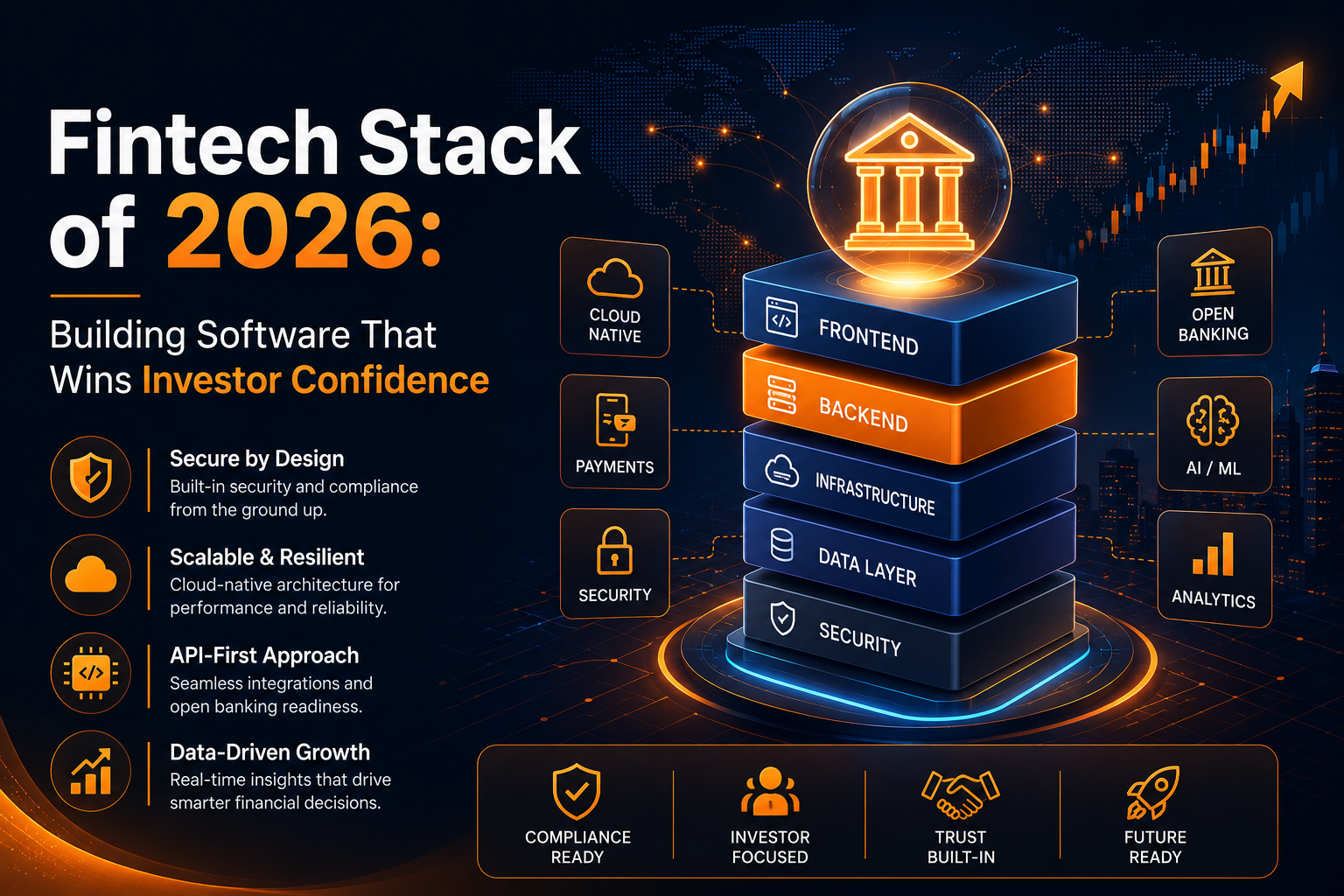
A winning stack today is built on “pluggability”. This is the ability to connect with other banks, payment processors, and apps through secure APIs.
- The Backend: Efficiency is very important. Developers are choosing Go (Golang) or Node.js as high-performance languages. They are excellent choices mainly because they do not slow down even when handling a large number of tasks simultaneously. Besides that, TypeScript has been added to the list of necessities, as it helps catch bugs early, thereby making your financial logic error-free.
- Database Management: You can’t rely on just one type of database anymore. Most successful platforms use a hybrid approach. They use PostgreSQL for things that require absolute accuracy (like bank balances) and NoSQL options, such as MongoDB, for handling the mountain of data generated by user behaviour and real-time analytics.
- The User Experience (Frontend): First impressions matter. Tools like React and Next.js allow you to build dashboards that are not only pretty but also incredibly fast. If a user has to wait three seconds for their balance to load, they might leave, and investors know it.
- AI in Fintech: Beyond the Basic Chatbot
- By 2026, AI in fintech will have grown up. It’s no longer just a pop-up window that answers basic questions. Investors are now looking for “AI-first” companies that use AI to run their businesses.
- Autonomous Agents: We are seeing “agentic AI” that can actually perform tasks, like deciding if someone is eligible for a loan or investigating a suspicious transaction, all without a human having to click a button.
- Growth through Personalisation: By using machine learning to understand exactly how a customer spends their money, you can offer them the right product at the exact moment they need it. This makes your CRM for business growth far more effective than traditional marketing.
- Scalability and the “Zero Trust” Security Model
If your app crashes during a major shopping holiday or a market surge, your reputation is ruined. This is why scalable fintech software is the most talked-about topic in due diligence meetings.
- Microservices and Kubernetes: Imagine your software as a fleet of small boats instead of one big ship. If one boat runs into engine trouble, the rest of the fleet can still move. Kubernetes is used to automatically handle such ‘boats’, increasing the number of ‘boats’ during a traffic rush and decreasing it when traffic gets quiet.
- Secure Software Solutions: Hackers are getting smarter, so your defence has to be better. In 2026, we will use behavioural biometrics (identifying users by how they type or move their mouse) and zero-trust architectures (never assuming a user is safe just because they logged in). When you prioritise secure software solutions, you show investors that you are protecting their investment from catastrophic leaks.
- Enterprise-Ready and Embedded Finance
To go from a small startup to a major player, your software needs to be ready for the “big leagues”. This involves providing enterprise software solutions that other companies can use.
This is often called embedded finance. It means your software is so well-built that a clothing store or a car dealership could “plug” your banking features into their own app. This flexibility is a hallmark of high-quality web & software development and is a massive green flag for venture capitalists looking for the next unicorn.
Conclusion
Building a fintech platform in 2026 is about finding the sweet spot between bold innovation and careful risk management. To truly win investor confidence, you must move past the “move fast and break things” era. Instead, focus on creating a modular, AI-driven, and highly compliant infrastructure that can grow without friction. By focusing on secure software solutions and professional enterprise software solutions, you position your brand as a leader in the global fintech digital transformation.
FAQs
Q1. What makes a fintech software stack investor-ready?
A: An investor-ready stack should be secure, modular, and easy to scale. It needs clean code and documentation that shows the system can handle millions of users without crashing; thus, the technology will grow smoothly along with the business.
Q2. Which technologies are critical for scalable fintech platforms?
A: Cloud-native tools like Docker and Kubernetes are used by scalable fintech platforms to handle traffic. Microservices enable various parts of the application to expand independently, and the use of fast programming languages like Go or Rust guarantees the system remains quick and stable.
Q3. How does AI improve fintech software?
A: AI is used to speed up tasks such as identity verification and fraud detection while giving individuals financial guidance. By observing user behaviour patterns, it allows customers to save more efficiently, which makes the platform more valuable, user-friendly, and prosperous for the business.
Q4. How can fintech startups ensure compliance with regulations?
A: Startups implement Compliance as Code to encode the rules, such as KYC, into their software. By leveraging AI-powered RegTech solutions, they are continuously aligned with laws like GDPR and PSD3, thus ensuring security as well as compliance with the law without the need for a big legal department.
Q5. What are the common pitfalls in building fintech software?
A: Many startups fail by building a “monolith”, one giant, messy piece of software that is impossible to update. Others ignore security until it’s too late or fail to make their data “talk” to different parts of the system. Planning for data growth and security from day one is the only way to avoid these expensive mistakes.