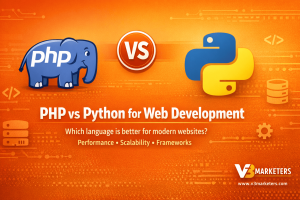


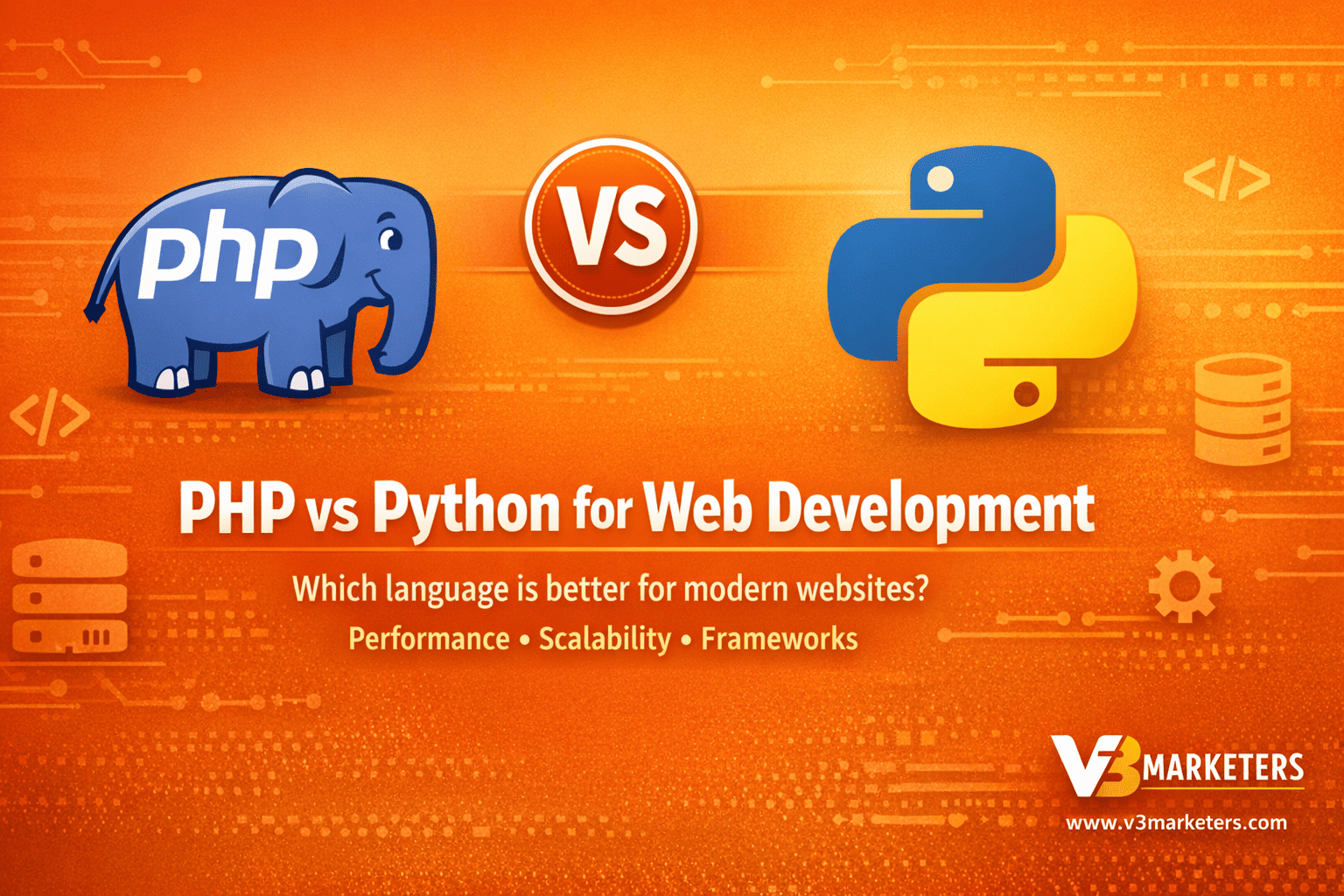
Tech changes all the time, and the question of PHP vs Python is still one of the hottest topics among developers as well as business owners. When entering 2026, the digital world has moved on to AI integration, super-fast performance, and modular architectures.
Here, you will understand the key differences between PHP and Python for web development, also find out the upcoming web development trends for 2026 and finally figure out which language is your perfect match for your project needs. Whether it is a simple website or a complex AI platform that you are developing, your first step for success is identifying the strengths of PHP vs Python 2026.
The Landscape of Web Development in 2026
2026 will be an interesting turning point for the internet. Many people had forecasted the “death” of traditional languages, but the actual situation is very different. PHP remains behind more than 70% of the web’s server-side logic mainly because it is deeply integrated in CMSs like WordPress. However, Python for web applications has become very popular as it is the go-to language for AI and ML.
Why the Choice Matters
Choosing the best web development programming language is not only about syntax, but also the entire ecosystem. It is not only coding that developers in 2026 will be doing, but also integrating microservices and adding smart functionalities.
PHP: The Battle-Tested Veteran
PHP has evolved significantly in performance and robustness over the last twenty years, with developers using PHP 8.4 and 8.5 extensively. Features like JIT have further closed the performance gap between this and other languages as we near the end of 2026!
Key Strengths of PHP for Backend Development
- PHP is designed solely for HTML, so it differs from other general-purpose languages because it is specifically made for web pages.
- Laravel (still the most used framework) is available with inbuilt tools for authentication and real-time data changes.
- PHP Hosting is offered by a wide variety of hosting providers, so that PHP becomes the cheapest solution for small and medium-sized companies.
Python: The AI-Ready Heavyweight
Python has transcended its roots as a scripting tool to become the “glue” of modern technology. In the context of PHP vs Python for web development, Python is the go-to choice when your application needs to do more than just display data.
Why Python for Web Applications is Winning
- Integration of AI and Data: With Python’s libraries (like PyTorch, Scikit-learn), integrated with Django or Flask, 2026 will have a recommendation engine or chatbot.
- Readability: Known for its clean syntax, code written in Python is easily readable. With the growth of remote, global teams, having “readable” code is essential for maintaining the code.
- Multipurpose Usage: A developer who is experienced in Python can complete backend tasks, analyse data, and develop and run automated scripts.
Performance and Speed: PHP vs Python
A common question in the PHP vs Python debate is speed. In raw execution for standard web requests, modern PHP often beats Python. However, Python vs PHP performance isn’t just about how fast a page loads. It’s about how the language handles concurrency.
- PHPis ideal for “stateless” web requests; each time a user visits a new page, the script executes and then ceases operating after that individual user leaves the application.
- Python is best suited for “stateful” applications; i.e. the server must track previous interactions from users and/or perform intensive calculations that do not block the user interface.
Web Development Trends 2026
To make a better choice, it’s necessary to look at the web development trends 2026 that are shaping the industry:
- Serverless Architectures: Both PHP and Python have adapted to support this type of architecture. However, because of Python’s lightweight nature, it has become more popular for use with AWS Lambda and Google Cloud Functions.
- Headless CMS – PHP is reinventing itself as a headless content management system by providing an API that serves as the backend for React or Vue. js-based frontend rather than rendering an entire webpage.
- AI-Driven Personalisation: This is where Python for web applications stands out from other languages, as it enables developers to create websites that learn from the user’s interaction with the website in real time.
Real-World Examples
- Facebook and Slack continue using PHP for fundamental back-end parts of their systems that serve many users (overall traffic).
- Companies like Instagram and Spotify have a significant reliance on Python for complicated processing of their data, as well as personalisation of the feeds to each user (i.e., outputs).
Read More:- Is YouTube a Social Media Platform?
Conclusion
There is no clear winner when it comes to the battle of PHP vs Python 2026. If you are developing a conventional e-commerce store, a blog, or a business portal where the speed of development and hosting costs are the main considerations, then go with PHP. It still ranks the best programming language for web development if the topic of discussion is content management. Choose Python if your project is “future-proofed” with AI, requires complex data analysis, or is built on a microservices architecture. Python for web applications is the gold standard for innovation in 2026.
Regardless of what you decide, each language has lively communities and will stay important during the next ten years. The most suitable language is one that enables your project to get off to an effective launch, as well as providing the means for effective scaling at the correct points in time.
FAQs
Q1. Which is better for web development in 2026: PHP or Python?
A: It entirely depends on your project. PHP is ideal for a site that is content-heavy or a typical e-commerce store. However, Python works better if you want to add AI, machine learning, or engage in complex data processing.
Q2. Is Python faster than PHP for backend performance?
A: Usually, that’s not the case. The latest PHP (8.x +) combined with JIT can be faster for typical web request, response cycles. Python, on the other hand, might be a better option in terms of efficiency for long-running processes and asynchronous tasks.
Q3. Is PHP still relevant for web development in 2026?
A: Yes. PHP will continue to make up 80%+ of the internet’s traffic, and it continues to improve at such a fast rate that it will easily compete with all other languages that have recently emerged.
Q4. Which language is more scalable for large web applications: PHP or Python?
A: Both languages can scale nicely. PHP works really well if you want to scale up (use bigger servers), whereas Python’s community and tools are a bit more advanced for scaling out and creating microservices.
Q5. Should startups choose PHP or Python for their first web project?
A: Startups that want a fast MVP (Minimum Viable Product) and cheap hosting usually go for PHP/Laravel. If a startup is into data science or AI kinds of products, then they should pick Python.